My Life on a Kibbutz – Chapter 5

Dear readers I have been thinking it would be a good time to delve into a little of the history of Kibbutz Metzer where I was staying, especially in the light of the ongoing conflict in Gaza. I must admit I was a little unclear of its story. I didn’t think about it much when I was there and the little I did know has been somewhat lost in my memory. Now I do not understand why I neglected to learn more when I was there. Life there was full of sunshine and laughter and, with the energy and enthusiasm of youth, life was for living in the moment. (Just a quick aside, I still feel I am the same person, though some may disagree but, perhaps it’s the world that is no longer so kind.) So now a little learning for all of us on the formation of Kibbutz Metzer.

Kibbutz Metzer is located in the north of Israel. I am now chuckling because of the next piece of information. In turns out that the Hapoel Tel Aviv basketball team is sponsored by SP Metzer – an acronym for “Super Pipe” made by the super successful pipe factory at the kibbutz. You will recall my outrage at being asked to roll pipes around a huge spool and the laughter by the workers that followed. Perhaps my attempts made them realise how much better they could be and spurred them on to make their factory such an industrial success. Just think, I could have been the impetus to improve, perhaps! . By the way, the factory started out as a pillow factory (yes, pillows) called “Kermetz”. It’s not really clear how pillows turned into pipes, but apparently they just needed a comfortable pillow to lay their head on and dream.

Metzer was built in the heart of an Arab population. Founded in 1953 by young pioneers from Argentina. Over the years the Kibbutz maintained friendly relations with its Arab neighbours and with a continued desire for peaceful coexistence. This co-operation went both ways. When the kibbutz could not locate a viable source of water, the nearby Arab village of Meiser connected Metzer to its own small well. The two communities worked together over the decades, dousing a threatened bush fire together, shared sports activities and even formed a soccer team that competed in the regional league. In 2002 the kibbutz board had protested Israel’s plan to build a security fence through their area because it would cut through the olive groves belonging to the West Bank Arab village of Kefin and would deprive the farmers of 60% of their fields. Then came a murderous attack. An Arab man from another area entered the Kibbutz and killed 3 adults and 2 children. But the long history of coexistence between the kibbutz and the neighbouring villages prevailed, despite the crises. In 2004, when the security fence was constructed, the kibbutz offered to construct a tunnel under the wall to receive sewage and to pump water back to their neighbours for irrigation. Contrast this with what was going on in the West Bank and in Gaza at that time, a walled prison containing more than a million people and now today it is worse than one can ever have imagined. Let us hope that, like the Jews of Metzer and their Arab neighbours after the attack in 2002 that in the darkest hours, humans are capable of drawing from their common well of humanity.

Well, dear readers, this has been educational for us but I am sorry to end on such a note although with a tinge of hope. I wonder how the Kibbutz is fairing now? I had planned to regale you with some of my travels and move on to other travels and adventures I have experienced but, once again, I leave you all in anticipation of the next chapter. How about lying in the Dead Sea reading a book or the desert in a sand storm. I will leave you with these pictures in your mind. Until the next time.

Marguerite Ruffle

My life on a Kibbutz – Chapter 4

Dear readers,

You will be anxious to know how my stint in the high school progressed after leaving me chopping and dicing onions and garlic. Well it didn’t. Not because I wasn’t up to this task or because I was forced to keep my distance from all because of this new-found aroma that I carried on my person. It was in fact because of the need for extra volunteers in harvesting the apricots. Hurrah! 

Rising at 4.15 – yes me – to be on the trailer by 4.30 to be at the orchards for 5 and the picking began. I arose at the allotted time. I admit to a distinct lack of the springiness of step but I was awake, just. The sun was not yet up, perhaps just peeking above the horizon but there was warmth in the air. What we would call a pleasant summer’s day. There was much yawning and stretching of volunteers during the first half of the morning as we climbed ladders and collected the apricots. One draw back was the inevitable hunger pains and we did avail ourselves of one or two of the fruits despite knowing that the hunger pains would be overtaken by indigestion. Perhaps you have guessed, but the apricots were not yet ripe as most were being shipped abroad so, like the bananas, were still at the green stage. 

After a few days of tummy pains most of us decided to put up with the hunger. At 8 o’clock we were taken back to the kibbutz for breakfast. Remember it was vegetarian so no bacon, but it was a glorious feast of vegetables, cheeses, yoghurts….I don’t need to list it all but I must say I’ve never again had such a breakfast. 

With full stomachs we returned to the orchards and picked the fruit until 11 o’clock. By this time the heat of the sun was beginning to burn us and we were glad to get back to the shade of our dormitories to wash then lunch and to the swimming pool. Wonderful.

There came often in these days of apricot picking the realisation that here I was in an orchard in the Holy Land on a day of peace and in the beauty of both the land and the sky. What stories this land had to tell?

Here is a little information about the kibbutzim:
When I lived on the kibbutz in the ‘70’s the idealistic kibbutz movement was in transition. The first kibbutz was established in 1910 and over decades dozens more were formed, about 270 to date but only about 3% of the population, across the territory that would become Israel. The kibbutzim had been formed before the state of Israel to help in the building of an Israeli state. Many were formed by young Jews from Eastern Europe who believed in a Jewish homeland. Others came to escape antisemitism and later, the Holocaust. For them the Kibbutz was like an extended family. They lived by their motto:

“From each according to his ability, to each according to his need.” 

As Israeli society evolved from a scrappy generation of land-harvesting pioneers to the hi-tech generation of a nation, kibbutzim had to adjust to a new age of capitalism, gradually having to adapt their socialist ideas to fit into the world markets.

Despite their small numbers, kibbutzim have had much cultural and political influence on Israel for much of its history and many politicians, military leaders, intellectuals and artists coming from Kibbutzim. Politics in kibbutzim are associated with the left-wing and peace solutions.

Enough facts for now but I would like to tell you a bit about the Kibbutz Metzer where I was a volunteer and of my travels in Israel next time.

Marguerite

News from the Guild

We held our Annual General Meeting on the 26th November 2024. There were fifteen of us gathered in the hall. A goodly number and I just wondered if the promise of lots of cake might have helped. We discussed the year’s events and talked about the syllabus for the year ahead. The 2025 syllabus will be out by the time you read this so make sure you get your copy and check in the church magazine for our upcoming events, three of which are being held on a Wednesday. Do tell your friends and relatives what a friendly bunch we are and, with a fun-filled and interesting syllabus for the year ahead, they may want to come along.

We all gathered in the hall on the 11th December for our Church Christmas Lunch. The hall was beautifully decorated thanks to Jessie and Irene Stephen. We were served, once again, a lovely meal by the girls from Jackie’s Catering Service. We had carol singing from the Alison Bishop Singers and we were invited to join in which we did with gusto. We played an interesting game of ‘Pass the Parcel’ devised by Irene. There were two circles. The inner one for the men and the outer one for the women. There were a few prizes too – of novelty socks. Well done to the winners. We all left for home happy and full and full of he joy that Christmas brings.

A date for your diary – The Church Guild resumes on the Tuesday 11th February.

I am writing this on the 25th February, Rabbie Burn’s birthday so I thought you might like to read an account from the ‘Ward Chapel Castle Street Congregational Church Junior Guild Minute Book’ of the “Burn’s Supper 24th January 1956 7.30 start. Tickets 2/6 Attendance – 115.”

(It then listed the contributors to the evening, customary for a traditional Burn’s Supper, with the toasts, soloists and even a violin solo. The Rev. T.R.S. Campbell gave “The Immortal Memory”. The songs were “Bonnie Wee Thing”, “Ca’ the Ewes”, “Ae Fond Kiss” and “O’ Whisle and I’ll cam tae ye’” and the evening finished with “Auld Lang Syne”. The accompanist was Mrs. W.H. Duncan.)

“Supper:- Haggis, mashed potatoes, mashed turnip, trifle and jelly, tea and cakes, orange juice. 120 people were catered for and we finished with 18/4 in hand. Mr. Spence provided the potatoes, which the ladies of the committee cooked and brought down hot. Trifles and jellies were made by members of the committee. Cakes were ordered from D.P.M. also cream for trifles. Posies of Christmas Roses (given by Mrs. Blackwood), Anemones and Jasmine were arranged by Mrs. Donaldson and Mrs. Thoms and tastefully set at intervals along the tables. Supper cloths, dishes, cutlery, tumblers etc. all provided by Committee. 

The evening (the first of its kind held in Ward Chapel) was an unqualified success and went without a hitch from start to finish.”

In another entry from the minute book it says, “We opened the evening with the “Ward Chapel Handshake” game. Here is a question for you all. What is the “Ward Chapel Handshake” game? 

Marguerite Ruffle

Latest from The Guild

Our first Church Guild meeting after the summer was on 15th October and we started with a swing, performing some of our now well-known seated exercises with perhaps a few tweaks as I had misplaced the original moves. I do, however, think the new ones are better but will we remember them for next time? We had a new member in our midst who joined in with much enthusiasm. After a jolly start this new member was to be our guest speaker. He was none other than our own minister, the Rev. Alan Gibbon. He had brought along his guitar but, more importantly, his trusted companion Dexy who has been writing sterling pieces for us to read in the church magazine. He soon endeared himself to us and I think there were some of us vying for his attention with some success.

The minister, using songs, regaled us with stories of his childhood in Lochee, his family and their origins. We joined in the songs and were entertained by his stories. Alan is very interested in his family tree so he was able to tell us more of his family’s origins in the north of Scotland and how they came to Dundee. Of course the last song had to be, ‘The Road and the Miles tae Dundee’ which we sang with gusto. We finished up, as always, with lovely refreshments and a good blether. We hope Dexy enjoyed himself and will return. Maybe he’ll mention his visit in the church newsletter.

We met up again on the 22nd for some party games such as Musical Hats and some parlour games which were supposed to oil the brains but did they? My favourite was the after-eight game but I fear that not everyone was inclined to join in and just ate their chocolate but some of us gamely persevered to get the chocolate from our forehead to our mouth with, I’m afraid, little success but a lot of laughter. We finished up with a nod to Halloween with a scary story where all joined in the actions. Thanks to Irene for the Halloween decorations and cakes.

After a longer than usual break we met up again on the 12th November when James Lochead gave a talk on ‘The Tartan Pimpernel’. This was the story of Donald Caskie, born on the Isle of Islay in 1902 and who was minister of the Scots Kirk in Paris at the time of the German occupation in Paris. He had several opportunities to flee but instead stayed behind to help establish a network of safe houses and escape routes for allied soldiers and airmen trapped in occupied territory.

He was arrested and sentenced to death and it was only through the intervention of a German pastor that he was saved. After the war, Caskie returned to the Scots Kirk, where he served as minister until 1960. This inspiring story of selfless commitment to others in the face of extreme adversity is the legacy of a truly brave man. Thankyou James for telling his story lest we forget all the brave people we owe so much. We hope James will be back soon with more of his stories.

The AGM is on 26th November where all are welcome to come along and any ideas for future meetings will be much appreciated. After, there will, of course, be cake and a blether.

The Church Christmas Lunch is near and there is a form in the hall to add your name. The cost is £22 for a three course lunch, coffee and tea and fabulous entertainment.

Marguerite

My life on a Kibbutz – Chapter 3

For those readers who have not been following my time on Metzer Kibbutz in 1977 (I was very, very young you understand.), I am now relaying the events of yet another attempt at securing suitable work, necessary to secure my board and lodgings.

So here I am, early morning, sun shining, boarding a bus to take us to the Mosad, the high school for older children shared with 3 other Kibbutzim. The passengers were a motley crew of teachers – the stoney faced variety, pupils – the very lively and loud variety, and four bleary-eyed volunteers with accompanying yawns. The bus was not of the plush variety we are more used to today but more akin to the old berry buses, and the road being more of a track in places meant a little cat-nap was impossible as it bumped, scraped, and jiggled along to our destination, taking about 30 minutes but which seemed much, much longer.

On arrival, I saw a long two-storey building in an L shape and to the side a football pitch and one for netball with already pupils from other kibbutzim gathered in little groups. First, the teachers descended and disappeared into the building. Eric, the ‘old-timer’ of our group of four, advised us to wait, as the pupils descended loudly from the bus and scattered into the playground. I am sure the advice was given according to whatever health and safety rules were around to protect us from being trampled underfoot in the stampede.

After a safe exit from the bus, he led us to a side door into the school kitchen. Eric stayed behind in the kitchen and we three remaining were asked to stand by the door to the dining room to help serve breakfast along with some other volunteers. As events unfolded, I use the word ‘volunteer’ with some reluctance. A bell rang and two doors leading into the playground were pushed open and the hordes descended, throwing themselves onto the benches that ran along each side of the long wooden tables. The room was soon filled with noise and bodies all vying for attention. They clicked their fingers in the direction of the server nearest for more water, bread and, to my amazement, bacon. It seemed that although bacon was not eaten by adults it was given to children. I had some later as a wee treat as I lived on a kibbutz of vegetarians. It looked a bit different from ours but was really tasty.

Back to the dining room. I was, at this time, not much older than some of the pupils, and being brought up in the tradition of children being seen and not heard, I baulked at this clicking and shouting for attention. Now, whether it was that having spent my childhood in deference to adults I didn’t see why these pupils should not also have this experience or maybe it was because I found their behaviour just rude but, after serving two pupils, I returned to the kitchen to announce that I was better suited to working in the kitchen. I can’t remember the exact words I used but maybe that is just as well.

But there was to be retribution at my rebelling. I was put on peeling onions and garlic duty and some of the health-giving bulbs were none too healthy themselves. I wasn’t the only one to rebel, albeit after a very short time. The other two volunteers with me threw in the towel soon after and those from the other kibbutz were not far behind. It seemed this particular job always had a steady stream of new volunteers and Eric, the stalwart, had endeared himself to the chefs and so was given light duties in the kitchen. He too had given up on the dining room.

I’ve run out of room but, dear readers, you’ll be pleased to know the next chapter has some good news and some history and facts about the Metzer Kibbutz.

Marguerite

Dundee Sea Cadets Mark Their 85th Anniversary

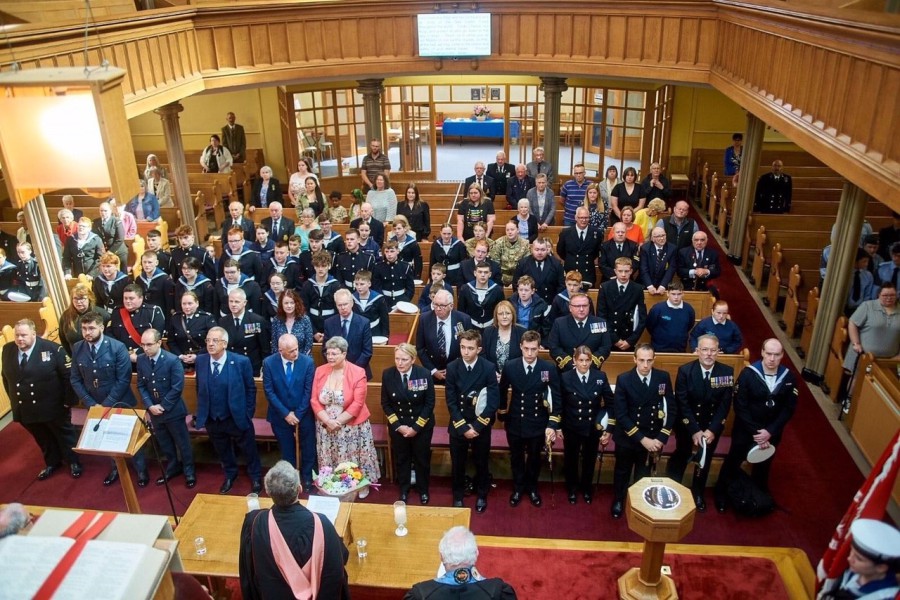
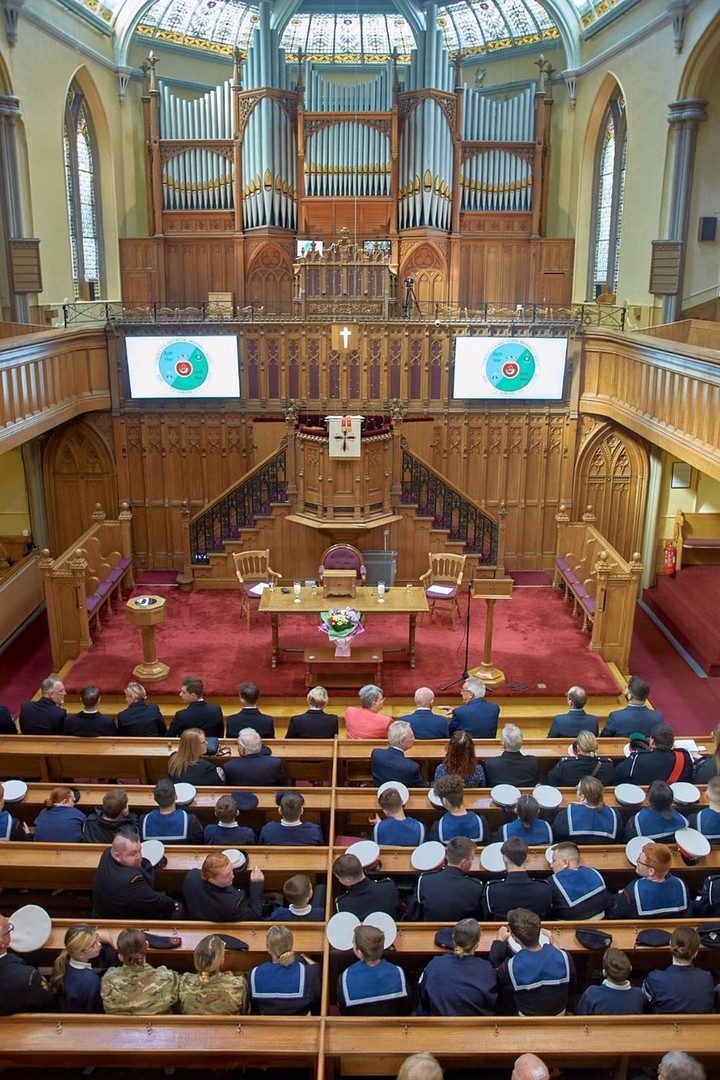
On Saturday 10th August 2024 at 10a.m. our church was given the honour of hosting Dundee Sea Cadets as they celebrated the 85th Anniversary of their inauguration at the very beginning of World War 2 in 1939. This wonderfully impressive congregation of nearly 150 mostly uniformed young people (see pictures on the front & back pages) graced the heart of our church for an unforgettable celebration. The Service was conducted by Rev Gordon Campbell of Perth Congregational Church as Chaplain to Dundee Sea Cadets, with our own minister Rev Alan Gibbon extending a warm welcome and Rev Bob Wightman as Chaplain of the Combined Ex-Services` Association taking part.

To start this special day Rev Campbell created the perfect image of 85 years ago when Dundee Sea Cadets were formed by pointing out that this date covered King George V1`s first visit to Canada and the United States being the very first by a reigning British sovereign. This was also the year our future Queen, as Princess Elizabeth, first met her future husband Prince Philip of Greece on a visit to the Britannia Royal Naval College at Dartmouth. However, above all this was the start of the six long years of WW2 which was a very auspicious date indeed with some of the new cadets eventually serving their country and tragically losing their young lives in the years ahead.

PO Barry Ross, Commanding Officer Training Ship Duncan gave the history of Admiral Adam Duncan and the creation of Camperdown:-

Adam was born in Dundee and joined the Royal Navy in 1746, being promoted Admiral in June 1795. He saw action in many campaigns but also had long periods without pay because the 18th century Royal Navy kept officers on the books but didn`t pay them if we were at peace! Duncan is best known for the Battle of Camperdown between British and Dutch Forces in 1797. Under his command this was a complete strategic victory for the Royal Navy as they captured eleven Dutch ships and lost none of their own. That is the origin of Camperdown Park and the statue of Admiral Duncan outside Dundee`s St. Paul`s Cathedral at which wreaths were laid later in the afternoon.

Commander Ross ended this history with the poignant words:

“We commit ourselves to remember”.

Special prayers were made by Rev Campbell, Rev Gibbon and Rev Wightman and these were interspersed by three rousing hymns sung with tremendous power and feeling to surge to the rafters of our ancient building:

“O God our help in ages past”

“One more step along the world I go”

“Eternal Father strong to save”

Thought-provoking readings were given by cadets themselves. The final prayer by Rev Campbell I print here as it is sincerely applicable to the troubled times still facing many parts of the world in the 21st century as we remember such a famous Dundonian of over three centuries ago.

“Eternal God, we thank you for 85 years of TS Duncan – for all who have served – for friendships made, and things learned, and lives changed. We give thanks also for the wider cadet family – for other Sea Cadet Units, the Army Cadet Forces, and the RAF Air Cadets – for the difference each makes in their localities. We remember too the armed services, the Royal Navy and the Royal Marines, the Army and the RAF. Amid global tensions keep them safe – and give them courage to meet all occasions with discipline and loyalty.”

The Service was brought to a close by the powerful singing of the National Anthem which ended the rousing singing accompanied by the superb organ music of our organist Prof. Norman Beedie.

The next stage of this special celebration was marked by the band of the 6th and 7th battalions of the Royal Regiment of Scotland who accompanied all the cadets and their Colours as they paraded en route from our church to Dundee High School, past the McManus Galleries and down to the City Square, where the participants were greeted by Depute Lord Provost Christina Roberts before some of their guests were treated to a Civic Reception in the City Chambers. However, the reason for the naming of the Cadet Training Ship “Duncan” was not bypassed as wreaths were laid at Adam Duncan`s statue outside St. Paul`s.

This colourful and very significant occasion was shown at its best by the distinguished and hallowed beautiful interior of our own church and we have every reason to be very proud of the entire unique event.

EMC


War Widows Association Service

The War Widows’ Association held a Service in our Church on Saturday 14th September to lay up their old Scottish Standard and dedicate and receive their new Standard for Scotland.

The Service was conducted by Rev. Bob Wightman who is Chaplain to City of Dundee Combined Ex-Services Association to which the War Widows are associated. The Lord Provost, Mr. Bill Campbell opened the Service by bringing greetings on behalf of City of Dundee and thanked the War Widows for all the good work they do and wished them every success and happiness in the future. Bible readings were given by Sir Alistair Irwin, Hon President of City of Dundee Combined Ex-Services Association and Mrs. Mary Wightman.

The old Scottish Standard was carried into the Church by a very capable young lady, Able Cadet Abi Barrie who is the Standard bearer for War Widows’ Association in Scotland and had travelled all the way from Inverness with her proud parents. She handed it over to Rev. Bob who laid it up in Dundee Congregational Church for safekeeping and the new Scottish Standard was dedicated by Rev. Bob and presented to Abi for her safekeeping on behalf of the War Widows’ Association in Scotland.

Mrs Sue Raw, Secretary of War Widows’ Association, gave a very poignant and moving talk on the history and the work done by the ladies of the Association and the camaraderie and understanding they have for each other when they meet whether on social occasions or at poignant services such as Remembrance Day. She also touched on the fact that not every War Widow has lost a husband on the battle ground but also through mental anguishes and not being able to cope in the aftermath. She finished her talk by reading a poem written by Mrs Kay Todd an early member of War Widows Association.

We will remember them
We will recall
Our yearly tribute, placing
The hopes and dreams that slowly had to fade
We will go on
The lonely future facing
Knowing too well the sacrifice you made.
We will forget
The loneliness and worry
The pain of parting and the tears we shed
Forget as well
The aching and the longing
Keeping our memories of the times we shared.
We will remember
Heads held high with pride
We will keep vigil
With our men who died.

Between 50 and 60 attended consisting of an eclectic mix of War Widows and families, dignitaries from various organisations, representatives from City of Dundee Combined Ex Services Association and four of their Standards which were also paraded into the Church. We were also delighted to welcome representation from the young Sea Cadets, two of whom uplifted the offering.

We sang three very appropriate Hymns and we left the Service to Vera Lynn singing, “We’ll meet again.

We all met in the Church hall where it was very obvious that everyone enjoyed good food and the most amazing fellowship and friendship which was overwhelming as everyone mixed with one another and am sure there were lots of stories being told from past and present times.

Sue also wished her thanks to be recorded to the Church Office Bearers for allowing them the use of the Church for both the Service and the refreshments afterwards. Also to all Church members who helped in a variety of ways to make the Service and the social time the success that it most certainly was.

Mary

It’s Guild Time Again

The Church Guild is open to all church members and relatives and friends are most welcome.  Our Guild afternoons always finish with refreshments and a blether.

The Church Guild resumes on Tuesday 15th October at 2:00pm.  Our minister will be giving a talk and we might just throw in some exercises for those who wish a challenge.

There is a change to the time of our next meeting which is now the following week, Tuesday 22nd October, where there will be party games hopefully accompanied by lots of frivolity and laughter.

Our next afternoon is our scheduled meeting on the 12th November when James Lochhead will be giving a talk on ‘The Tartan Pimpernel’. A tantalising title.

The Annual General Meeting is on the 26th November and be sure to come as they are never boring and there will be cake.

Our Church Christmas Lunch is on Wednesday 11th December, 12:00pm for 12:30pm.  This is a time to throw away these diets and enjoy a lovely meal and, after, we have some special entertainment for everyone.

If you wish to come along to the Christmas Lunch, just tell myself or any of the committee members of the Guild.  For all other days just come along for 2:00pm in the church hall.

MR

Minister’s Visiting

Over the months of June and July, I started visiting on behalf of the church, guided by Elspeth.   From August onwards, my working days for the church will usually be Tuesdays and Wednesdays.   

If I am planning to visit you, I will call in advance to arrange a convenient time.

Thanks for your patience.

Alan

Sunday Services

Most weeks, morning worship will be conducted by myself.

Leading worship when I am off on 4th August and 15th September will be Rev Bob Wightman.

29th September – Pulpit exchange: Rev Gordon Campbell will be leading worship here whilst I lead worship in Perth Congregational Church.

Alan